

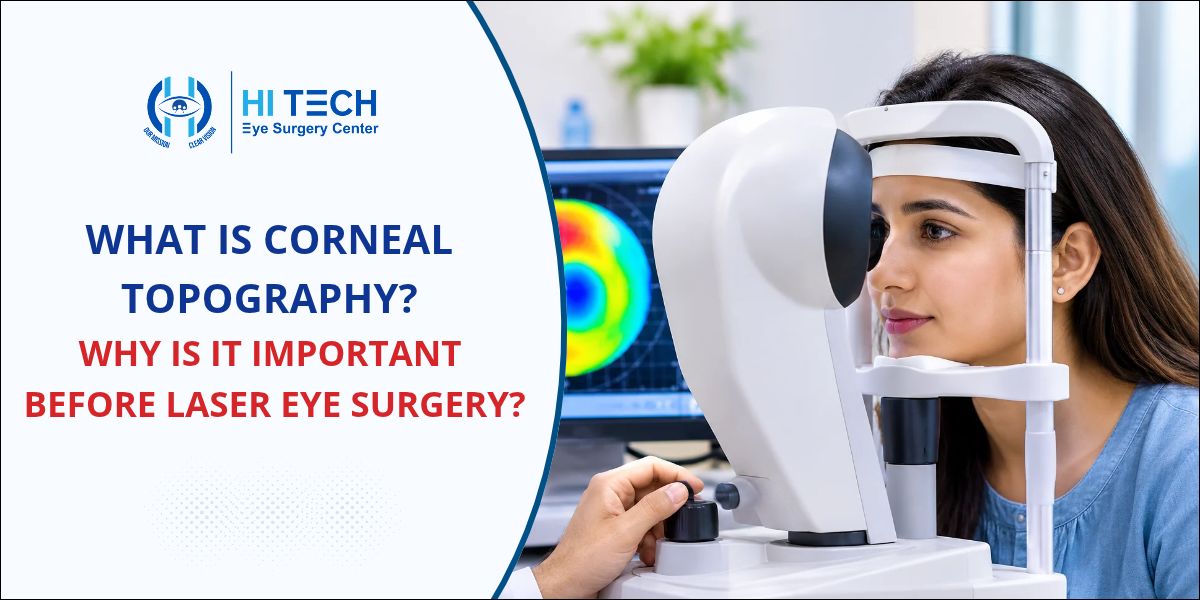
What Is Corneal Topography?
Laser eye surgery is a popular option for people who want to reduce their dependence on glasses or contact lenses. Procedures such as LASIK, Femto LASIK, and SMILE can help correct vision problems like nearsightedness, farsightedness, and astigmatism.
However, before undergoing laser eye surgery, it is important to check whether your eyes are suitable for the procedure. One of the most important tests performed during this evaluation is corneal topography.
Corneal topography helps eye specialists understand the shape and surface of the cornea. It provides detailed information about the front surface of the eye and helps doctors identify conditions that may affect the safety and results of laser vision correction.
If you are considering laser eye surgery in Pune, understanding corneal topography can help you make a more informed decision.
What Is Corneal Topography?
Corneal topography is a special eye test that creates a detailed map of the cornea. The cornea is the clear, dome-shaped front part of your eye that helps focus light so you can see clearly.
In a normal eye, the cornea has a smooth and regular shape. However, some people may have an uneven, irregular, or unusually steep cornea. These differences can affect how light enters the eye and how clearly a person sees.
Corneal topography uses advanced imaging technology to measure the curvature and shape of the cornea. The results are displayed as a colour-coded map, allowing the eye specialist to understand different areas of the cornea.
This test is quick, painless, and non-invasive. It does not involve any cuts or injections.
Why Is Corneal Topography Important Before Laser Eye Surgery?
Before performing LASIK or any other laser vision correction procedure, an eye surgeon needs to make sure that the cornea is healthy and has a suitable shape.
Corneal topography plays an important role in this decision. Here are some reasons why this test is necessary.
1. Helps Detect Keratoconus
One of the main reasons for performing corneal topography is to detect keratoconus.
Keratoconus is an eye condition in which the cornea gradually becomes thinner and bulges outward into a cone-like shape. This can cause blurred vision, increased sensitivity to light, and irregular astigmatism.
In some early cases, a person may not notice any major vision problems. However, corneal topography can help identify suspicious changes in the corneal shape.
This is important because performing standard laser vision correction on an eye with keratoconus or suspicious corneal changes may increase the risk of complications.
2. Checks the Shape and Curvature of the Cornea
Every person’s cornea has a different shape. Some corneas are naturally flatter, while others are steeper.
Corneal topography measures these differences and helps the surgeon understand whether the cornea is suitable for laser treatment.
An irregular corneal surface may affect the quality of vision after surgery. By studying the corneal map, the doctor can make a better decision about the most appropriate treatment.
3. Helps Reduce the Risk of Complications
Patient safety is one of the most important factors before laser eye surgery.
If the cornea is weak, unusually thin, or has an irregular shape, laser treatment may not be suitable.
Corneal topography helps identify certain risk factors before surgery. It can help doctors avoid procedures that may increase the chances of complications such as corneal ectasia, a condition in which the cornea becomes progressively weak and changes shape after surgery.
However, topography is only one part of the evaluation. Additional tests are also required to assess corneal thickness and overall eye health.
4. Helps Select the Right Laser Eye Surgery Procedure
Not every person is suitable for the same type of laser eye surgery.
Depending on the patient’s eye condition, the doctor may recommend:
- LASIK: A laser procedure that creates a thin flap in the cornea before reshaping the underlying tissue.
- Femto LASIK: Uses a femtosecond laser to create the corneal flap.
- SMILE: A minimally invasive laser procedure that removes a small piece of tissue from inside the cornea through a small opening.
- PRK: A surface laser procedure that reshapes the cornea without creating a corneal flap.
Corneal topography provides useful information that helps the surgeon assess which procedure may be appropriate. The final decision also depends on corneal thickness, prescription, eye health, and other examination findings.
5. Helps Improve Surgical Planning
Every eye is different, so laser eye surgery should be planned according to the patient’s individual eye measurements.
Corneal topography provides detailed information about corneal curvature and irregularities. This helps the surgeon understand the corneal shape and plan treatment more carefully.
In selected cases, additional corneal imaging may be required to study the front and back surfaces of the cornea.
Proper pre-surgery planning helps support safer treatment decisions and better visual outcomes.
How Is Corneal Topography Performed?
Many patients feel nervous before an eye test because they do not know what to expect. The good news is that corneal topography is simple and painless.
Here is how the test usually works:
- The patient is asked to sit comfortably in front of a special imaging machine.
- The patient rests their chin and forehead on the machine’s support.
- They are asked to look at a fixed target.
- The machine captures images of the cornea using light-based technology.
A detailed colour-coded map of the corneal surface is generated.
The test usually takes only a few minutes. There is no need for surgery, injections, or recovery time.
If you wear contact lenses, your doctor may ask you to stop wearing them for some time before the test because they can temporarily change the shape of the cornea.
What Do the Different Colours in a Corneal Topography Map Mean?
A corneal topography report contains different colours that represent variations in corneal curvature.
Generally:
- Warm colours (red and orange): Usually represent steeper areas of the cornea.
- Cool colours (blue and green): Usually represent flatter areas of the cornea.
However, the meaning of colours can vary depending on the machine, map type, and colour scale.
An eye specialist studies the complete pattern rather than looking at one colour alone. This helps identify whether the corneal shape is normal or requires further evaluation.
Who Should Get Corneal Topography Before Laser Eye Surgery?
Corneal topography is an important part of the pre-operative assessment for people considering laser vision correction.
It is particularly useful for:
- People planning to undergo LASIK, Femto LASIK, or SMILE.
- Patients with high or irregular astigmatism.
- People with a family history of keratoconus.
- Patients with suspicious corneal findings.
- Individuals whose vision or spectacle prescription changes frequently.
- People being evaluated for laser eye surgery for the first time.
If you are searching for the best eye hospital in Pune for LASIK surgery, choose a centre that performs a detailed pre-operative eye evaluation rather than focusing only on the laser procedure.
Are There Any Other Tests Required Before Laser Eye Surgery?
Yes. Corneal topography is important, but it is not the only test required before laser vision correction. Your eye specialist may recommend several tests, including:
- Corneal pachymetry: Measures the thickness of the cornea.
- Refraction test: Checks your spectacle power.
- Dry eye evaluation: Checks tear quality and quantity.
- Eye pressure test: Measures intraocular pressure.
- Retinal examination: Checks the health of the retina.
- Corneal tomography: Provides information about the front and back surfaces of the cornea and corneal thickness distribution.
These tests help the surgeon understand your overall eye health and decide whether laser eye surgery is safe and suitable.
Get Advanced Eye Care at Hi Tech Eye Surgery Center, Pune
Hi Tech Eye Surgery Center provides eye care and surgical services for patients in Pune. If you are considering laser vision correction, the centre can help you understand the importance of pre-operative eye tests and the steps involved in evaluating your suitability for surgery. Whether you are exploring LASIK, Femto LASIK, or other vision correction options, a detailed consultation and appropriate diagnostic evaluation are important before making a decision. Visit Hi Tech Eye Surgery Center in Undri, Kondhwa, Pune, for professional eye care and guidance on your vision correction needs.
Frequently Asked Questions (FAQs)
1. Is corneal topography necessary before LASIK surgery?
Yes. It helps assess corneal shape and identify irregularities that may affect surgical safety.
2. Is corneal topography painful?
No. It is a painless, non-invasive test that does not involve touching or cutting the eye.
3. How long does corneal topography take?
The test usually takes a few minutes to complete.
4. Can corneal topography detect keratoconus?
Yes. It can identify suspicious corneal patterns associated with keratoconus, although further tests may be needed for confirmation.
5. Does normal corneal topography mean I am suitable for LASIK?
Not necessarily. Corneal thickness, eye power, tear health, and overall eye condition must also be evaluated.

